We are in 2024 and just a couple of days ago- 2April24 editor Jeffrey R. Young published an article in EdSurge titled- Is it Time for a National Conversation about Eliminating Letter Grades.
This topic has been part of my own career journey for the last 30 years- I remember a university professor in my Masters’ program once asked why does it take 70% achievement to earn a passing grade of a C? and then only ten points more to earn a B and 20 points more to earn an A? Really what do these grades really represent? When I first started teaching in 1991 I remember trying to figure out how to grade- at first I gave homework assignments 10 points, tests 100 and special projects/tasks 20-50 points randomly determined with no clear justification. My gradebook was literally a paper book where I wrote every student’s name down, the assignment and how much they earned. Each week I would add their total points and then determine their weekly grades with simple math. As I started to think about it I wondered why I decided these point values and another colleague had a different system- this means that though the students were supposed to learn the same content they in fact were being evaluated by different systems- a total nightmare when considering what is equitable. And really nobody was asking what students were actually learning.
Fast forward- to Summer, 2008 when I served as an instructional leader and was tasked with meeting with students who were failing a grade and their families during the summer. The conversation was supposed to review the students’ outcomes and determine a plan of action to improve their academic progress the following year and determine if they will need to repeat the year. When I started looking at the teachers’ digital gradebooks I realized that I was not clear on what the grades were actually representing and what assignments ‘proved mastery.’ In addition I realized that like my own teaching experience each teacher had their own approach to grading to for the students it was like visiting Europe before the EU and the implementation of the euro- each teacher had their own grading currency. That summer I parsed out what is my moral obligation to the students and my legal limitations. In the State of CA the teacher’s gradebook is their own property and administrators may not change students’ grades. So in my thinking out of the box approach I created new classes for the students to complete with me as the teacher and the tasks based on demonstrating mastery of content. Students were assigned several summer homework tasks and given the opportunity to submit their work before school starts with the opportunity of earning the necessary credits to progress. 50% of the students achieved this opportunity and did not have to repeat the academic year.
In between these experiences I did teach at a school in the mid-nineties where we as a teacher team united and adopted a mastery based grading approach using the same criteria and descriptive language to describe the mastery levels. Having this
| Distinguished | Proficient | Apprentice | Novice |
| I am an expert and can teach others the material. | I am confident in the material. | I am mostly confident. | I am just learning. |
Now- with CTL Academy we are working with Mastery Transcript Consortium to create a mastery based, human skills oriented transcript that supports students with creating a portfolio including evaluation and feedback loops. This work allows the students to choose and put forth their own work samples as evidence of their learning. The process is highly reflective and iterative giving students the opportunity of receiving feedback from their teachers and sharing their response to it. Below is a sample of what it looks like:
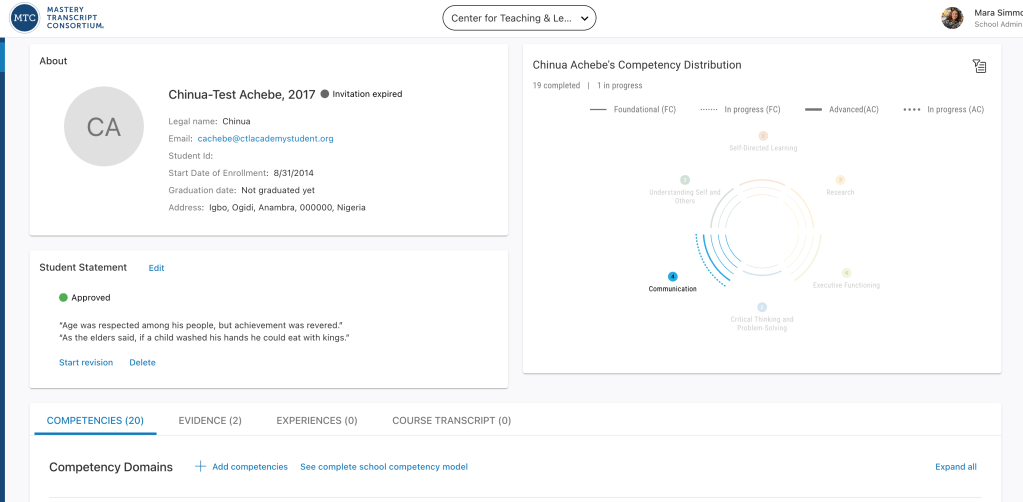
Moving forward we as educators and schools need to find ways to focus on student learning and communicating what students have achieved. No longer is the standard grade report card fit for purpose.
What do you think?
 Teaching Hacks 4 All