Making Schools Fit for Purpose
Presently I have come across many schools- private and public who continue to sustain more traditional educational models though their ethos, vision and mission are about preparing students for successful futures. For example a school might believe in the whole child or student-centered approach yet by the time the child is in secondary their exams define their learning. Alternatively there are schools that promote project based learning and senior portfolio defenses yet basic skills of students may not be so clearly evidenced and state test scores suggest there are gaps.
I believe schools must identify what is in their control as it relates to creating a journey of learning and then shape the best program going forward that benefits their community and reflects the ethos, vision and mission. Below are some tools that could help all schools in this transformation process.
Helpful Frameworks

We have to acknowledge that the future is completely different from what we are currently experiencing hence education must change. No longer should it suffice for us to sustain status quo or for parents to accept that the learning process is the same for their children as it was for themselves.
With this assumption I suggest looking at some interesting frameworks to help a school/organization reinvent their current practice. The first one is: The Future of the Portrait of a Graduate 2024. This is an interesting report by
Battelle for Kids that synthesizes what are the essential skills students need for the future.
Next I suggest schools look at the organization XQ’s competencies for schools. This document gives schools a rubric and descriptions of what makes for effective learning experiences to prepare students for their future.
Exam Support (IGCSE)

For schools committed to sustaining the use of 3rd party exams to measure student learning/outcomes it is critical to prepare students for these exams. This preparation includes both content learning and overall exam prep. There are specific test taking strategies that students need to master to achieve. This explicit practice is for any 3rd party exam i.e. Advanced Placement, SAT, ACT, GCSE/IGCSE.
For IGCSE I used ChatGPT to help create a study guide and identify key resources. One can do something similar for any exam- the key is identifying the specific exam strategies i.e. how questions are framed, what are students expected to respond, how answers are marked…
Webb’s Depth of Knowledge
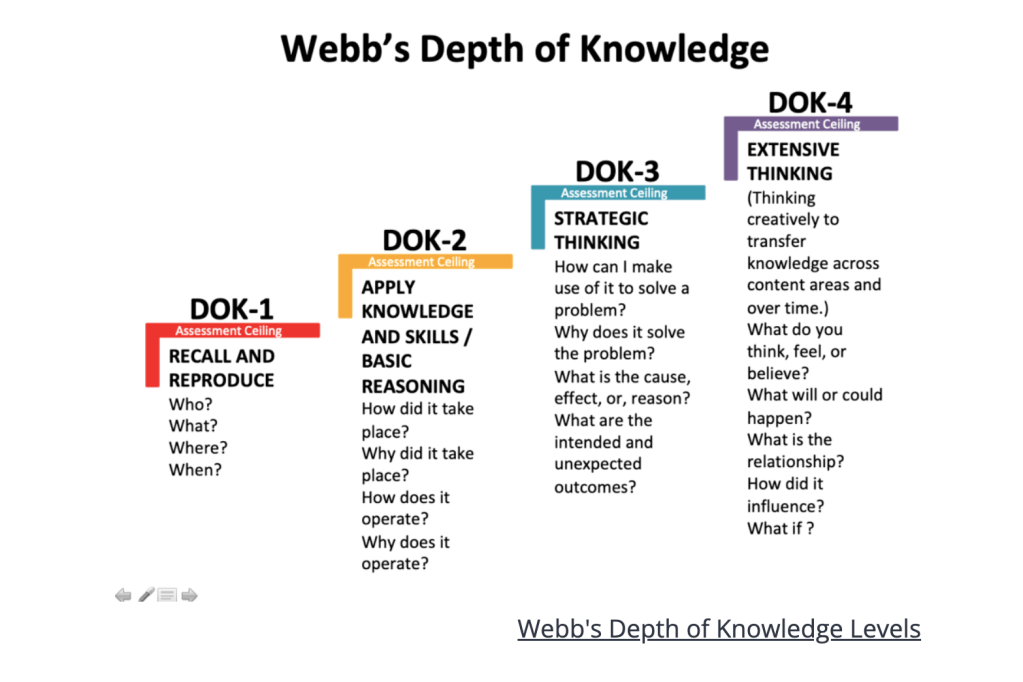
Building effective and impactful lessons take skill. Recently I learned about the role of an instructional designer- a person that applies learning theory to effective teaching to help teachers improve their overall lessons. Truly an amazing role to have on staff. Short of this expertise teachers need to up their game and BE INTENTIONAL in their lesson design.
Webb’s Depth of Knowledge is a tool to help teachers explicitly craft their learning tasks and aim at specific levels of learning. Here is a good article on the differences between Bloom’s Taxonomy and Webb’s. This website also has a good description and some additional resources to have a play with.
When writing lesson plans-either on your own or with the use of ChatGPT- be explicit as to what level of thinking you are wanting the students to achieve and be sure your assessment tasks match that. For fun you might evaluate a 3rd party exam to know what is expected of students externally as well.
For additional resources and tools please have a look in my toolbox.
 Teaching Hacks 4 All